Now You Really Know You Are a Novice!

Take a photography class. Then you really become self conscious of your photographs. I am now concerned with noise, exposure, coloring, Oh My!

I thought I would never hear about ISO again (work related joke) and now it’s on my camera! Histograms are now blinking at me and before I didn’t know I had one. Do I focus on one spot or multiple spots? Is my white balanced? I can’t even balance a checkbook! How can I capture a precious moment when I need to figure this all out?

I feel like all my photos are going down hill. I read an interesting post on Twitter or FaceBook that explains. I hope, what I am experiencing. I would share the link if I could remember where I saw it, but a personal summarization will have to do.

When you are creating a piece of work that you know is not perfect or really far from where it should be, that is not a bad thing! The secret is to not stop creating, keep working at it. A true artist knows when their work isn’t up to par, but they keep on painting, sculpting, writing, or whatever their passion may be.   Most people stop because they think at this point, “I will never be as good as the experts”.

Here are my latest pictures that I am practicing my new techniques on.  I will continue practicing so one day, maybe I’ll be good.  Geez, these are noisy pictures!

Great Blue Hereon

IMG_1865

Nutria aka River Rat

IMG_1818

Great Blue Heron

IMG_1871

White Ibis

IMG_1874

Juvenile White Ibis


My New Year’s Resolution and Retirement

IMG_1471

Recently, as of January 31, 2014 I have retired from 30 years in the public education system.  I am a single, retired female, 59 years young. With that being said, I know retirement for me is just a month’s vacation. I have chosen to stay at home to relax and rejuvenate before beginning the next leg of this journey called life.  Until I start my new career, I am focusing on my New Year’s resolution, to observe the birds in my own back yard. I am having so much fun!!!

My recliner has been re-purposed and turned around to face my backyard windows.  I sit for large amounts of the day watching all the birds that visit my southwest Texas home in the suburbs.  Before I know it, the day has gone by and I haven’t completed any chores, let alone bathe and get dressed.  This retirement could be hazardous to my health, but I am loving every single day!!!

So far the regular mix has included Mockingbirds, House Sparrows, Northern Cardinals, Mourning Doves, and Blue Jays.  When the Carolina Chickadees, Yellow-rumped Warblers, and House Finches visit my backyard I really am excited.  There are always a few other birds that drop by that I can’t identify confidently.

IMG_1483

House Finch


The biggest discovery and observation has been the activity of the other creatures that roam my backyard during the day.  When the House Sparrows begin to chip frantically I know a cat is nearby.  But the most entertaining culprits have been the squirrels.  The squirrels and I are opponents and so far I have only made their overall quest to steal from the bird feeders more challenging.  Here are few amusing photographs to enjoy.  These are taken in sequence and as the last picture illustrates, the squirrel has conquered this game again.  Beat by a squirrel!

Aha! I have you baffled!

Aha! I have you baffled!

Darn, foiled again!

Darn, foiled again!


Added another baffler and now I have you!

Added another baffler and now I have you!

IMG_1479

Foiled again!!!!


The First Birds of 2014

One of my goals for birding this year is to pay more attention to the birds in my neigborhood.  That is what I did today.  It was an overcast day so the lighting for pictures was not too great.  The first birds I identified were Yellow-rumped Warblers.  There was a whole group of the warblers hanging out in my backyard.  They are easy to spot because of their yellow rump.

yellowrump

The yellow rump is showing here.

You can always count on a Mockingbird to show up in the backyard.  This one was rather plump.

Mockingbird

Mockingbird sitting on my gutter.

A female Northern Cardinal discovered my mirror and was quite alarmed at the other bird staring back at her.

Fotor0104214218

A female Northern Cardinal amused with the bird looking back at her.

Just down the street was a pond with my favorite ducks, the Black-bellied Whistling Ducks.  More birds were hanging out at the University Memorial Park close to the house.  Enjoy these photos of birds in my neighborhood.

blackbellied Whistling ducks

Black-bellied Whistling Ducks

American Coot

American Coot

Great tailed Grackle

Great-tailed Grackle

Lesser Scaups 2

Lesser Scaups

Ring-necked Ducks

These ducks should be called Ring-billed ducks, but their name is Ring-necked Ducks.

Semi-palmated sandpiper

Semi-palmated Sandpiper


Kill Deer

Kill Deer Flying to join his mate. I never noticed the brown patch on tail before.

A good beginning to 2014!

Ending the 2013 Year with a Whooping Crane Adventure

What better way to end my real first year of birding than with one of the most unique bird sightings along the southern Texas coastline.  My goal for this birding trip was to see the endangered Whooping Cranes in their winter home.  After entertaining our families for the holidays, we began preparations for the next birding adventure. My birding friend and I reserved our seats on The Skimmer with Captain Tommy for this adventure.  I had heard that the best way to view the Whooping Cranes was to observe them by boat in the Aransas Bay. 

In my mind, I thought I was going to see a flock of Whooping Cranes similar to the migrating White Pelicans that you see this time of year. 

white pelicans 159

White Pelicans in Aransas Pass Bay

white pelicans 165

White Pelicans in Aransas Pass Bay

These White Pelicans who migrate to the southern coastal states in the winter stay together as a group most of the time. White Pelicans even feed together working the shallow marsh waters for fish and then scooping up their food with their large bills.  White Pelicans do not dive for their food like the Brown Pelican.  This bird is one of the largest North American birds, but it is about 30 percent smaller than the Whooping Crane. 

Most of the Whooping Cranes migrate from Wood Buffalo National Park, Alberta, Canada to the coastal waters of Texas near the Aransas Pass Wildlife Refuge near Rockport. The cranes come to this area of Texas to feed on the Blue Crabs. This crane is the largest North American Bird. When standing, the crane is about 5 feet tall. In flight, the wing span is about 7.5 feet. 

In an effort to increase the Whooping Crane population, there have been some recent reintroduction efforts by Operation Migration in Wisconsin.  These cranes migrate to Florida for the winter.  Whooping Cranes mate for life, unless their partner dies and then they will search for a new mate.  They will lay only two eggs.  Once the first egg hatches, they will discard or leave the second egg to perish. Operation Migration has taken the discarded eggs to raise the Whooping Cranes in captivity.  Whooping Crane parents will feed and take care of their young for about 6 to 8 months.  After a year the young bird is on on their own. These birds are very territorial, so they don’t really hang out together like other migrating flocks.  These birds will be living in an area as a family or as a couple. 

The first sighting for us was at the Aransas Pass Wildlife Refuge on foot.  We were walking along the Heron Trail and saw two Whooping Cranes from a distance.  These two cranes were demonstrating their whooping call.  The loud whooping call is bellowed out in unison by both parents.

First Sighting of Whooping Cranes 029

First Sighting of Whooping Cranes

Listening to their unique call puts a smile on a birder’s face.  We were very anxious to see these birds up-close the following day.  The day we visited the Aransas Pass Wildlife Refuge the weather was in the 70’s and the sun was shining.  Below is a picture of us on the Aransas Pass Wildlife Refuge Observation Tower basking in the sunshine. The park rangers warned us that the weather for the following day was going to be in the 40’s with light showers.  But we were prepared for the cold weather with leggings, special fingerless gloves, and lots of layers. 

Happy Birders at Aransas Pass Wildlife Refuge

Happy Birders at Aransas Pass Wildlife Refuge Observation Tower

The next day the weather was just as predicted, it was cold and rainy.  But Captain Tommy was ready for us.  His tours are amazing!  His expertise at identifying birds in the Aransas Bay is amazing.  As a beginner birder, I am in awe of his quick identification. Even though our goal was to see the Whooping Cranes, we were fortunate to see so many other migrating and local birds living in the marshes this time of the year. Predators were among the marshes as well, like the Northern Harrier. We even captured some photos of a coyote living out in the marshes.  I am still trying to figure out how a coyote managed to get out to these marshes.   One of my favorite bird to photgraph is the Oyster Catcher. These brightly colored birds were busily feeding on the natural oyster beds in the bay.

Northern Harrier

Northern Harrier


oyster catchers 149

Oyster Catchers

coyote on the prowl 085

Coyote on the Prowl

We saw several couples of Whooping Canes, even one crane that was banded.  But my favorite of all the crane sightings was the Whooping Crane family.  The juvenile crane still has the molting brownish feathers.  The juvenile crane was closly monitored by the parents.  As the boat crept up to the cranes, the parents communicated to the juvenile to get between them and they flew to safer grounds.  It was awesome to see these three huge birds lift those huge bodies into their graceful flight with their beautiful black tipped wings.

banded whooping crane 065

A Banded Whooping Crane

juvenile whooping crane 109

A Juvenile Whooping Crane


Whooping Crane Family

Whooping Crane Family

whooping crane family in flight 113

Whooping Crane Family in Flight

What a great way to end 2013 and gear up for new birding in 2014!

I Love Black-bellied Whistling Ducks!

One of my favorite ducks is really not like any other duck.  The Black-bellied Whistling Duck is unique and lives all year round in the southeast part of Texas. I believe they live in some parts of Louisiana and Arkansas too.  I have read that these ducks are flocking in great numbers to Audubon Park in New Orleans.

I just love watching these “gregarious” ducks, as they are often called in my Texas surroundings. Gregarious, because they stick together in large flocks. They are very social ducks. These ducks have a very distinct bird call that sounds like a whistle as they fly from their nesting grounds to their feeding grounds. Black-bellied Whistling Ducks usually stay with one mate and they take care of their ducklings together.  Here is a photo I took of this little family of birds swimming in the algae covered lakes in Brazos Bend State Park.

Whistling Ducks at Brazos October 2013

I have noticed that the Black-bellied Whistling ducks like to nest around water and in grass covered fields.  There were known at one time as tree ducks because they like to perch in trees.  I have not personally witnessed the perching in trees, but they do like to perch. Below are some photos that I took yesterday while visiting my parents in a Del Webb community in Fort Bend County.  This planned community has some beautiful man made lakes. This flock of Black-bellied Whistling Ducks have claimed Del Webb as their home.  I wonder if they know there is a rule that you must be 55 or older to reside in this community. One of their favorite perching spots is on the rod-iron fence by the clubhouse.  These ducks could possible be a nuisance to some of the Del Webb residents, but I could sit and watch these ducks for hours!

BBWD-Clubhouse 2

Black-bellied Whistling Ducks perched at the Del Webb Clubhouse.

BBWD-Clubhouse 3

Black-bellied Whistling Ducks

BBWD-Perch 3

Black-bellied Whistling Ducks posing for pictures.

I think the main reason I love these ducks is because they are so easy to identify. Ducks are hard for me to distinguish between.  The distinct features of the Black-bellied Whistling Ducks make them so easy to identify.  These ducks have long necks and they protrude them out more than any other duck. Their bright reddish-pink bill and pink legs are hard not to miss.  The black belly and the beautiful chestnut color on their heads and rest of their body make them exotic.  The distinct white feather band on their wings makes them easy to identify in flight. They also have a bright white eye ring that makes their eyes easy to photograph.

BBWD_ close up

Black-bellied Whistling Ducks are very colorful!

Since these ducks are very gregarious, they are a blast to watch especially as they fly in to perch next to each other on the rail. Each Duck seemed to experiment with their own landing techniques.

BBWD-prepare for landing

Joining the flock at the country club.

Once these ducks arrive they are welcomed by the others. Sometimes they are not always greeted in a favorable way. Perhaps this is where the term “angry birds” came from. Just watching the unusual ways they perch on the rail is amusing. Be sure to check out the one-legged headless duck.

BBWD- Welcome commitee

The Welcome Committee

BBWD-angry bird

Angry Birds

BBWD- Headless

One-legged Headless Black-bellied Whistling Duck

As I have read and learned more about these regional ducks, I have recently corrected a misconception that I had about these ducks.  As these ducks were flying over our homes making their beautiful whistling calls in the evening, I just assumed they were going home to their nests.  I found out that at dusk these birds are probably flying to a feeding area. They eat in the evening and fly to surrounding farming areas to feed on seeds.  So the next time you hear the whistling ducks go by, I hope you have a real good picture of them in your heads.

BBWD-close up in flight


Birding in La Jolla, California

Last November I went to see my daughter and son in law in California, they are always so good about humoring me with my birding passion.  My previous posting was all about my birding on the San Diego River.  My daughter manages a Keller Williams Realty office in La Jolla, CA.  It’s a paradise to work in, a little oceanside community nestled on the west coast with quant little shops, delightful restaurants, and beautiful resorts.  So, when my daughter said she had to work for awhile, I jumped at the chance to go with her.  Packed with my binoculars, camera, and bird book, I jumped in the car to head to La Jolla.

The west coast is so different than the Gulf coast where I usually go birding.  Walking to the oceanside usually includes lots of climbing up and down steep inclines. The beaches are surrounded with dominating cliffs, so the hike to put your toes in the water involves steep inclines or long stairways. La Jolla Cove is a popular beach area.  The cove has a protected  area for swimmers.  It has one of the most popular ocean  locations for those dedicated athletes that swim for exercise or to train for triathalons.  Not only is this a popular spot for humans to visit but there are many birds and mammals who call this area home.  They live on the majestic cliffs of La Jolla and often pose for the clicking cameras.  Below are some of the photo-shots I took while walking along the cliffs of La Jolla Cove.

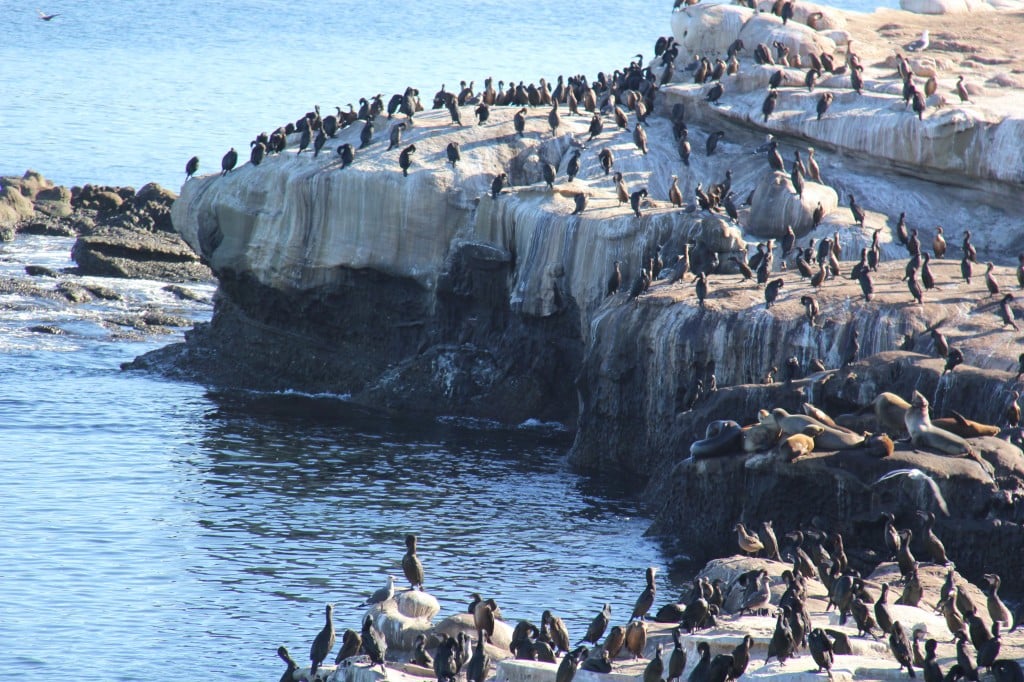
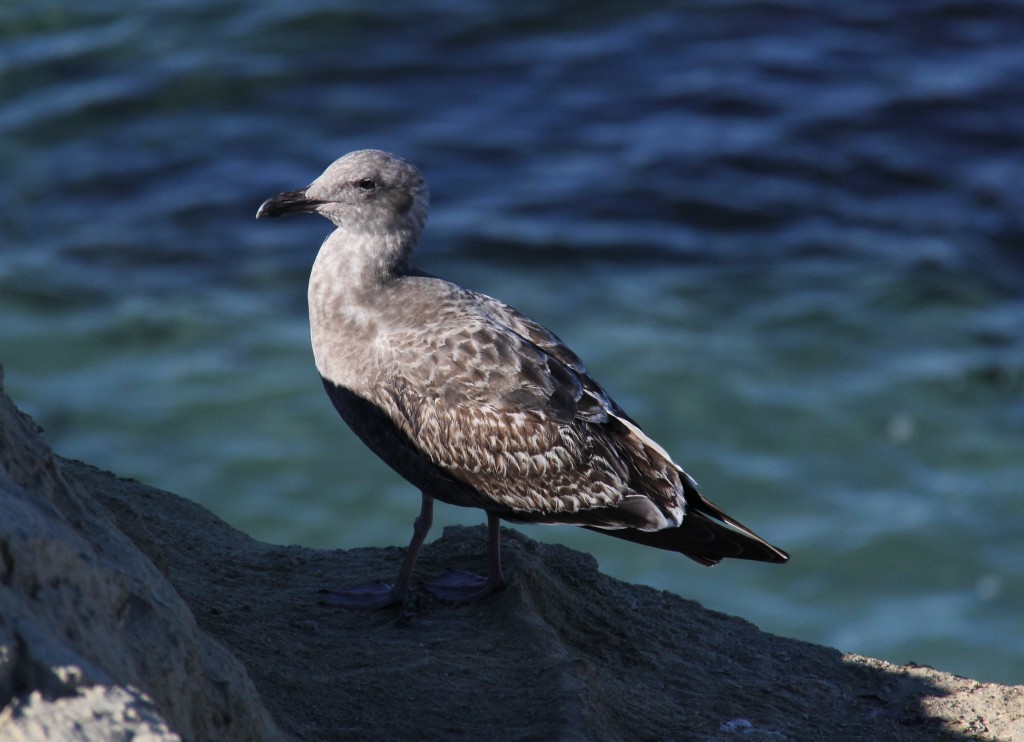
La Jolla Commorants, Seals, Gulls, Brown Pelicans

Seals, Cormorants, Seagulls, and Brown Pelicans are all sunning themselves on the cliffs of La Jolla.


At first glance this photo looks like penguins on ice, but these are Cormorants sitting on rocky cliffs that have been eroded over the years with the help of bird droppings.

At first glance this photo looks like penguins on ice, but these are Cormorants sitting on rocky cliffs that have been eroded over the years with the help of bird droppings.

Brown Pelicans were abundant on the cliffs this day.

Brown Pelican perched on the edge of a cliff looking over the icy cold blue waters of La Jolla Cove.

Brown Pelican perched on the edge of a cliff looking over the icy cold blue waters of La Jolla Cove.

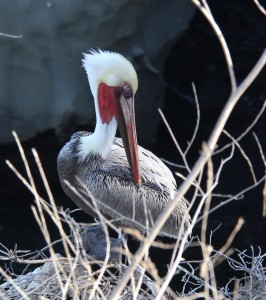
The red throat is a typical feature of a breeding Brown Pelican.


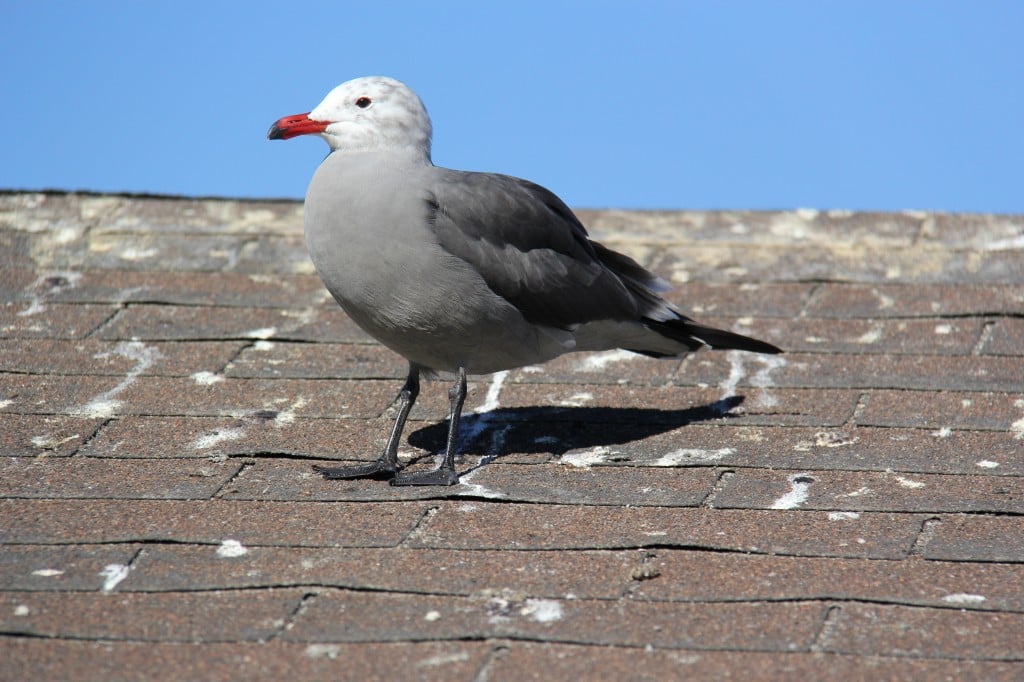
Heermanns Gull, possibly a breeding adult.

Heermanns Gull, possibly a breeding adult.


Juvenile California Gull

Juvenile California Gull

A California ground squirrel peaks over the thick leaves of the ice plant on the cliffs in La Jolla Cove.


Birding on the San Diego River

One of my favorite places to visit is San Diego, sunny California. I always have the pleasure of visiting my family members and sneaking in a few birding trips. On my last visit, the week before Thanksgiving, my daughter and her sweet husband took me to one of my favorite birding spots, San Diego River. On my very first trip to this river, I can remember the excitement when we saw a male Belted Kingfisher. Unfortunately, that was before my camera days. I would of loved to capture that bright blue bird with his rust colored breast band for my bird photo gallery. Every time I visit the river, I know I will see lots of interesting species.

Daughter and Mom

On my 2013 Thanksgiving trip the river was full of activity. There were so many birds there that I really couldn’t identify them all. Busily working the banks were the Long-billed Dowitchers. They were probing in the muddy banks for something good to eat.

Long-billed Dowitchers

Long-billed Dowitchers

Walking up and down the banks was this lone Whimbrel with his long down-curved bill. Identifyng this bird was a challenge, I studied the coloring carefully. This could of easily been a juvenile of the bird in my next photo, the Long-Billed Curlew. Any confirmations or corrections on my novice identifications are welcomed from my fellow birders.

Whimbrel

Whimbrel

Long-billed Curlew

Long-billed Curlew

This Long-billed Curlew appeared to be having some kind of beak problem. At first glance, it appeared the beak was injured, but I wonder, is it possible for beaks to molt?

There were so many birds there on the mudflats that I had trouble identifying them all. Hundreds of small birds were running all over the banks, maybe Sanderlings, a mystery? Click on the below picture, you can see the tiny specks running in the back part of photo. In the middle of the picture a Great Blue Heron stood, and some ducks were gathered at the front of picture.

Lots of birds!

Lots of birds!

Below is a close up of one of the birds that I believed to be scurrying on the mud banks.

Mystery bird? Maybe Sanderling?

Mystery bird? Maybe Sanderling?

The birds swimming in the water are plentiful in this area as well. I don’t think I have ever visited the river that I didn’t see an elegant Clarkes Grebe swimming the waters. Cormorants are always around as well. I am guessing we saw a Double-crested Cormorant or a Brand’s Cormorant. It is still too hard for me to tell the difference. But for this trip we want to rename this bird to, the “Batman Cormorant”. It is always interesting to watch these birds dry out their wings. It really isn’t just for show, these birds do not have oil in their feathers like ducks do, so they will dry them out in the sun.

Clarkes Grebe

Clarkes Grebe

;

Cormorant

Cormorant

Batman Cormorant

Batman Cormorant

There were several ducks in the water, the Northern Shovelers were the largest group visitng the river today. Below are other pictures of birds spending their day on the San Diego River.

Northern Shoveler

Northern Shoveler

;

Black Neck Stilt

Black Neck Stilt

Little Blue Heron and American Coot

;

Snowy Egret

Snowy Egret

These were just a few of the birds that we saw on our November visit to the river. you can see now why I LOVE to visit this place everytime I come to San Diego. I want to thank my super son in law for introducing me to this place. He might be sorry that he did, because it’s a place I want to visit every time I come to San Diego. Maybe next time you can drop your old mother in law off at the river with a lawn chair and a cooler. But I do enjoy sharing my birding with you guys! Mom and son in inlaw

Birding on the Skimmer in Rockport, Texas

This past September my overall objective was to learn all about hummingbirds in this area of Texas, see previous blog.  That mission was accomplished! An additional treat to the  the weekend we boarded a “three-hour tour” in the Aransas Bay area on the Skimmer! Luckily our Captain, Tommy Moore, did not have the same luck as the Captain on S.S. Minnow and we all survived to share our bird sightings.  skimmer

This is a trip I would like to take again during a different time of the year.  The Captain was awesome and very knowledgeable. There were not as many birds in Aransas Bay as there are in other seasons, but we still had some treats.  The bird sighting that excited me the most was a bird you usually only see over water, The Magnificent Frigate Bird.  He was sighted first sitting between two Pelicans out in the middle of the bay.  Hummer Bird Celebration 2013 135

Then he took his flight across the bay, his wing span was amazing.  This was a new bird for my count. The picture was fuzzy but I was too excited to focus correctly.

Hummer Bird Celebration 2013 138

We saw a few more wading birds hanging out on the islands, like the long billed curlew seen in the picture below.

Hummer Bird Celebration 2013 152

Here is a picture of the whole gang all together.  Lots of terns gathered together with a few other birds.  Click on the picture for a close up view.

Hummer Bird Celebration 2013 153

Wading in the shallow water, in the picture below, are two of one of my favorite species, the Oyster Catcher.  I just love their bright orange beak.  This is one powerful beak too! It can pry a shell open and enjoy a dinner on mollusks or oysters.  I think these guys below were just probing the mud flats for worms and crabs.

Hummer Bird Celebration 2013 159

My closing picture, is a photo of the species the boat was named after,  the Skimmer. What a grand time for all!

Hummer Bird Celebration 2013 157


The End of a Season

Is been a long time since I have posted a blog. This is the first weekend in a long time that I have felt like I had time to blog. A couple of weeks ago, at the beginning of October, a norther blew in and it marked the end of the hummingbird season here in South Texas.

I had three very active feeders in my backyard prior to the norther. There were about 6-8 birds hovering around the feeders almost daily till dusk. Seeing those fascinating birds hover, dive bomb each other, and feed from feeders and backyard flowers was so relaxing. Mosquitoes were plentiful so I set up a chair by the back bay window and sat there in the evenings when I made it home before dark. If I watched them carefully with my binoculars I would even catch a quick glimpse of their super long tongue.

september 30 022a  september 30 005 022

For the most part, the species that visited my backyard was the Ruby-throated hummingbird.  I think it is possible towards the end of the season that I might of had some Black-chinned hummingbird visitors. Sometimes I thought I would see a flash of purple.

This season I learned so much about hummingbirds. Before this year, I thought hummingbirds only survived on nectar, but they eat insects! I thought their beaks were like straws, but they have long tongues that lap up the nectar. Their nests are the size of a golf ball.  The female builds the nest and will usually lay two eggs that are the size of a tic tac mint.

These birds are fattening up here in my backyard to get ready to go on an amazing nonstop journey across the Gulf of Mexico. Hummingbird hearts can beat up to 1,200 beats per minute. I learned that these birds can go into a “topor state”, it’s a hibernation state where they can slow down their heart rate to about the speed of a human heart, 80 beats per minute. These birds go into this torpor rate at night, but I think I witnessed this state even during the day when these tiny birds perched on a branch or feeder and didn’t move for 19-20 minutes. It was like they were frozen.

september 30 041

I was fortunate enough to attend the “Hummerfest” in Corpus this year. I was able to actually hear a hummingbird’s heart beat at a banding station. They held a ruby throated hummingbird to my ear. It sounded like a motor running at top speed. I did catch a glimpse of a Buff-bellied hummingbird on the tour. No pictures for me, but I was able to capture the glimpse for my brain.

Hummer Bird Celebration 2013 044 Hummer Bird Celebration 2013 046

Last weekend I took down my hummingbird feeders, washed them carefully, used my new little scrub brushes to clean all the feeding portals. I sadly packed my feeders away until next summer when these amazing tiny birds will visit again!

Are Those Whistling Ducks?

Black-bellied-Whistling-ducks-1phfik0.jpg


My sweet mom is reading all my blogs and she recently made the comment, “I read all your blogs but you never mentioned anything about the whistling ducks.” She was right!  I completely forgot to mention this special duck, which was one of my first birds to identify.

In my first blog I referred to the concept of a “starter bird” in birding.  This is the bird that might be the one that started your interest in birding.  I mentioned in that first blog that I thought my starter bird was the White Egret.  But in reality, there might be another bird that was a close second.

My parents recently moved into a new home with the neatest screened porch.  On the weekends I would sit with my mom at the end of the day. Almost every day in the winter months a flock of ducks would fly by making the most unique high pitched whistling sound. And every day my mom would say,  “I wonder what kind of duck that is?”.  When I began my birding class, I had the tools to identify that bird for my mom.  I was quite proud to be able to show her a close up picture of these colorful ducks, the Black-Bellied Whistling-Duck.

I was even more excited to see these ducks up close at Brazos Bend National Park. There were hundreds of these colorful ducks all nesting on a small island in the middle of the main lake at the park. They have bright red beaks, reddish pink legs, black belly, grey head, golden neck and chest with a white patch on their wings. Here are a few shots of these beautiful ducks.  Be sure to look at last photo at the Roseate Spoonbill that flew in to grab some lunch right in the middle of a flock of Black-bellied Whistling-Ducks. Click on pictures to enlarge.

Black-bellied Whistling duck IMG_0257 IMG_0311